Spring MVC – Sitemesh 3 Integration
Sitemesh is a web page layout/decoration framework that makes it easy to create applications with consistent layout/look and feel. I have used Sitemesh 2 for years and absolutely love it. Sitemesh 3 is a complete rewrite of the framework and has huge performance benefits. A full list of the new features is listed here. In this blog I will share the steps needed for integrating Sitemesh 3 in a Spring MVC application.
1. We start by creating a Maven based web application using my Spring archetype. Here is the generated pom.xml file with dependencies:
<?xml version="1.0" encoding="UTF-8"?>
<project xmlns="http://maven.apache.org/POM/4.0.0" xmlns:xsi="http://www.w3.org/2001/XMLSchema-instance" xsi:schemaLocation="http://maven.apache.org/POM/4.0.0 http://maven.apache.org/maven-v4_0_0.xsd">

	<modelVersion>4.0.0</modelVersion>
	<groupId>com.inflinx.blog</groupId>
	<artifactId>sitemesh3</artifactId>
	<name>sitemesh3</name>
	<packaging>war</packaging>
	<version>1.0.0</version>

	<properties>
		<org.springframework-version>3.1.1.RELEASE</org.springframework-version>
	</properties>

	<dependencies>
		<dependency>
			<groupId>org.springframework</groupId>
			<artifactId>spring-context</artifactId>
			<version>${org.springframework-version}</version>
			 <exclusions>
		         <exclusion>
		            <groupId>commons-logging</groupId>
		            <artifactId>commons-logging</artifactId>
		         </exclusion>
      		</exclusions>
		</dependency>

		<dependency>
			<groupId>org.springframework</groupId>
			<artifactId>spring-webmvc</artifactId>
			<version>${org.springframework-version}</version>
		</dependency>

		<dependency>
		     <groupId>cglib</groupId>
		     <artifactId>cglib</artifactId>
		     <version>2.2.2</version>
		     <scope>compile</scope>
		</dependency>

		<dependency>
			<groupId>javax.inject</groupId>
			<artifactId>javax.inject</artifactId>
			<version>1</version>
		</dependency>

		<dependency>
			<groupId>javax.validation</groupId>
			<artifactId>validation-api</artifactId>
			<version>1.0.0.GA</version>
			<scope>compile</scope>
		</dependency>

		<dependency>
			<groupId>org.hibernate</groupId>
			<artifactId>hibernate-validator</artifactId>
			<version>4.2.0.Final</version>
			<scope>compile</scope>
			<exclusions>
				<exclusion>
					<artifactId>slf4j-api</artifactId>
					<groupId>org.slf4j</groupId>
				</exclusion>
			</exclusions>
		</dependency>

		<dependency>
			<groupId>jstl</groupId>
			<artifactId>jstl</artifactId>
			<version>1.2</version>
		</dependency>

		<dependency>
      		<groupId>org.slf4j</groupId>
	      	<artifactId>jcl-over-slf4j</artifactId>
	      	<version>1.5.8</version>
  	 	</dependency>
   		<dependency>
      		<groupId>org.slf4j</groupId>
      		<artifactId>slf4j-api</artifactId>
      		<version>1.5.8</version>
   		</dependency>
	   <dependency>
	      <groupId>org.slf4j</groupId>
	      <artifactId>slf4j-log4j12</artifactId>
	      <version>1.5.8</version>
	   </dependency>

		<dependency>
			<groupId>log4j</groupId>
			<artifactId>log4j</artifactId>
			<version>1.2.14</version>
		</dependency>

		<dependency>
			<groupId>commons-lang</groupId>
			<artifactId>commons-lang</artifactId>
			<version>2.6</version>
		</dependency>

		<dependency>
			<groupId>javax.servlet</groupId>
			<artifactId>jsp-api</artifactId>
			<version>2.0</version>
	    	<scope>provided</scope>
		</dependency>

	</dependencies>
    <build>
        <plugins>
        	<plugin>
			    <groupId>org.mortbay.jetty</groupId>
			    <artifactId>maven-jetty-plugin</artifactId>
			</plugin>
            <plugin>
                <artifactId>maven-eclipse-plugin</artifactId>
                <version>2.9</version>
                <configuration>
                    <additionalProjectnatures>
                        <projectnature>org.springframework.ide.eclipse.core.springnature</projectnature>
                    </additionalProjectnatures>
                    <additionalBuildcommands>
                        <buildcommand>org.springframework.ide.eclipse.core.springbuilder</buildcommand>
                    </additionalBuildcommands>
                    <downloadSources>true</downloadSources>
                    <downloadJavadocs>true</downloadJavadocs>
                </configuration>
            </plugin>
            <plugin>
                <groupId>org.apache.maven.plugins</groupId>
                <artifactId>maven-compiler-plugin</artifactId>
                <version>2.3.2</version>
                <configuration>
                    <source>1.6</source>
                    <target>1.6</target>
                    <compilerArgument>-Xlint:all</compilerArgument>
                    <showWarnings>true</showWarnings>
                    <showDeprecation>true</showDeprecation>
                </configuration>
            </plugin>
        </plugins>
    </build>
</project>
2. To the web application we add the following Sitemesh 3 maven dependency:
		<dependency>
			<groupId>org.sitemesh</groupId>
			<artifactId>sitemesh</artifactId>
			<version>3.0-alpha-2</version>
		</dependency>
3. We then create a Sitemesh decorator containing common layout/look and feel that all the pages should have. Create a main.jsp file under WEB-INF/decorator folder with the following contents:
<html>
  <head>
    <title><sitemesh:write property='title'/></title>
    <sitemesh:write property='head'/>
  </head>

  <body>
    <div style="color: red">
    	<sitemesh:write property='body'/>
    </div>
  </body>

</html>
4. The next step is to let Sitemesh know about this decorator. This is done via sitemesh.xml file located under WEB-INF folder.
	<?xml version="1.0" encoding="UTF-8"?>
	<sitemesh>
 		<mapping path="/*" decorator="/WEB-INF/decorator/main.jsp"/>
	</sitemesh>
In the above configuration file, the mapping element tells Sitemesh to apply main.jsp decorator to all the pages. Other configuration options provided by Sitemesh 3 are listed here.
5. The final step in the integration is to add Sitemesh filter to web.xml.
  	<filter>
    	<filter-name>sitemesh</filter-name>
    	<filter-class>org.sitemesh.config.ConfigurableSiteMeshFilter</filter-class>
  	</filter>

 	<filter-mapping>
    	<filter-name>sitemesh</filter-name>
    	<url-pattern>/*</url-pattern>
  	</filter-mapping>
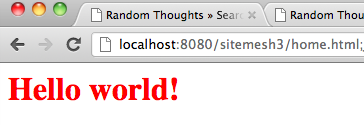
When you run the application you should see the red font color applied due to main.jsp decorator:
This post was helpful. Thanks!
Thanks Balaji for the example. I am using PHP as the the view technology with spring MVC following this article http://blog.caucho.com/2009/04/14/using-php-as-a-spring-mvc-view-via-quercus/. It works fine. But no luck so far integrating sitemesh 3. Any idea?
Hi Balaji, a little correction in your article – sitemesh.xml has to be renamed to sitemesh3.xml although it is sitemesh3.xml in your code. Thanks for the article.
sitemesh3 doesn’t support POST, if you try create a form with method = “post”, it will return errors,